Why Every Voice Matters: Unlocking Better Research with Full-Level B2B Audiences

When companies invest in B2B research, executives are often the first people researchers want to hear from. They control budgets, evaluate vendors, and set business priorities. But they’re not necessarily the people using the products being evaluated. If research stops at the executive level, it can miss the practical problems that determine whether a solution succeeds after purchase.
A company’s decision to buy a product is only part of the story. Managers have to figure out how to implement it, and employees have to use it in their daily work. Each group sees different benefits and challenges, which can lead to very different opinions about the same solution.
For researchers, this creates an important question: Are you capturing the full picture of a business decision, or just the perspective of the people who approve it?
How Different Roles Shape B2B Purchasing Decisions
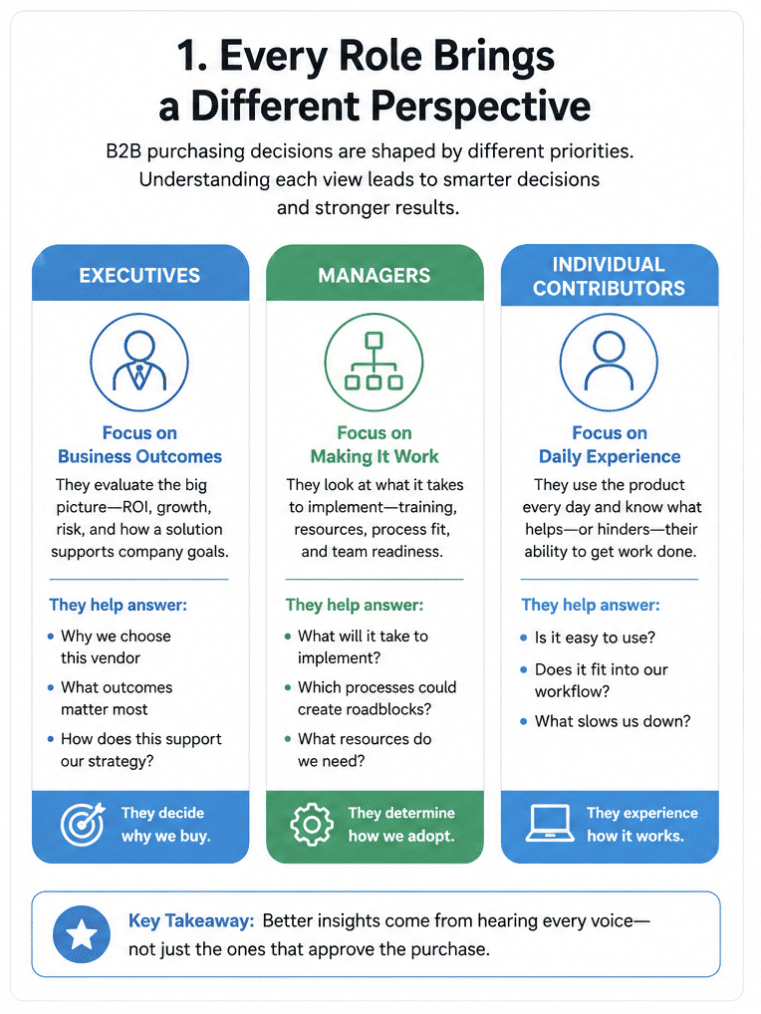
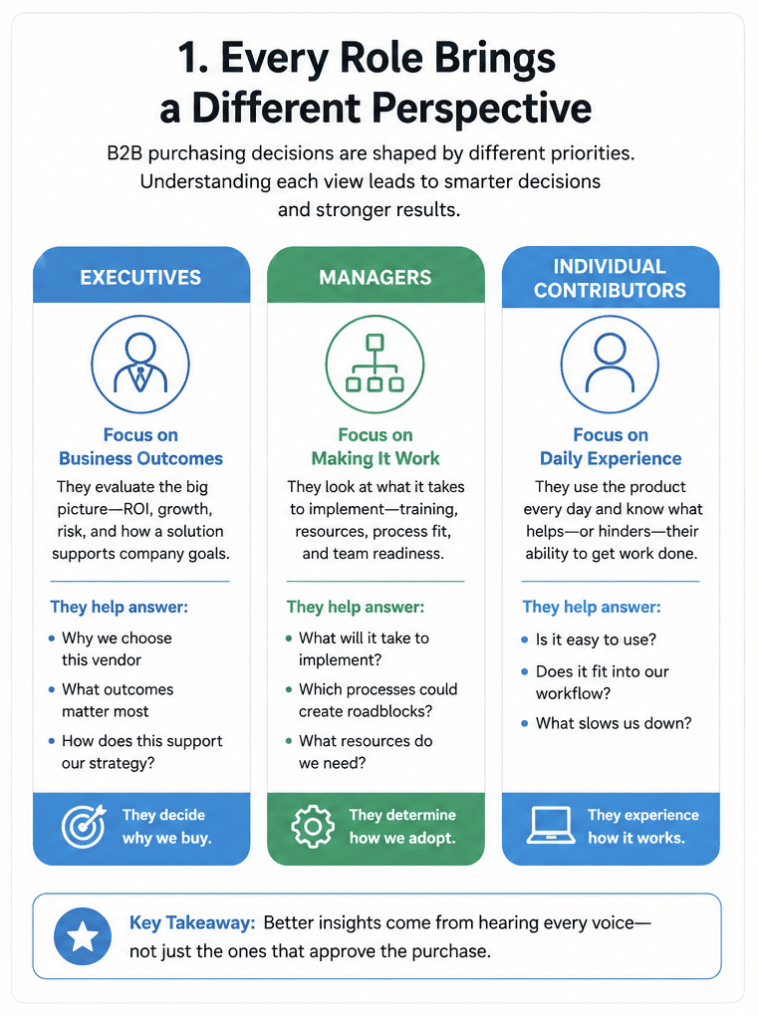
Executives, managers, and individual contributors don’t evaluate products in the same way. Their priorities depend on their responsibilities, and those differences can reveal important gaps in how a product is positioned, purchased, and used.
Executives focus on business outcomes. They’re likely to consider return on investment, long-term growth, risk, and whether a product supports company goals. When researching purchasing decisions, their feedback can help explain why a company would choose one vendor over another, what drives budget approval, and which outcomes matter most to leadership.
Managers look at what it takes to make a decision work. They may support a new platform but still have concerns about implementation time, training, staffing, or compatibility with existing processes. Their input helps researchers understand the practical requirements behind a purchasing decision.
Individual contributors experience the product firsthand. They’re often the first to notice when a tool adds unnecessary steps, lacks a useful feature, or doesn’t fit an established workflow. Their feedback can reveal usability issues that may not come up in conversations with senior decision-makers.
Why Executive Approval Doesn’t Always Lead to Adoption
A product can meet every requirement leadership sets and still struggle after launch. This happens when purchasing decisions are based on business benefits without enough consideration of the people responsible for implementation and daily use.
Consider a company introducing a new customer relationship management (CRM) platform. Leadership selects the platform because its reporting features promise better visibility into sales performance. From a purchasing perspective, the decision makes sense.
Once the platform is introduced, however, managers discover that the rollout requires more training time than expected. Employees also find that some information must be entered into both the new CRM and an existing system. To save time, they begin tracking certain activities in spreadsheets and updating the CRM later.
The problem isn’t necessarily that leadership chose the wrong product. It’s that the research informing the decision may not have accounted for the team’s actual workflow.
The consequences can extend beyond employee frustration. Duplicate data entry takes time, inconsistent records can undermine reporting, and managers may struggle to get the visibility that justified the purchase in the first place.
This is an illustrative scenario, not a documented client case study.
The Role Managers Play in Product Adoption
Managers have a direct influence on how new products and processes are introduced to a team. Even when leadership approves a purchase, managers often determine when employees start using the product, how much training they receive, and whether the new process becomes part of their regular work.
Imagine a department adopting new project management software during a busy reporting period. The manager may agree that the platform will improve collaboration but delay the rollout because the team doesn’t have time to learn another system. In another department, the same software might be introduced with dedicated training time and clear expectations for use.
The difference isn’t necessarily the product. It’s how the organization puts it into practice.
Their feedback can help answer questions that executives may not be able to address in detail:
- How much time and training will implementation require?
- Which existing processes could make adoption difficult?
- What resources would help employees transition to a new solution?
- What might prevent the team from using the product as intended?
Including managers in a study gives researchers a clearer view of the conditions that can influence whether a business decision succeeds.
What Individual Contributors Can Tell Researchers
Employees who use a product every day often notice problems that are easy to overlook during a purchasing evaluation.
Take a software platform that promises to simplify routine tasks. If employees have to switch between several screens to complete a single process, the product may add work instead of reducing it. They might start keeping their own notes, using spreadsheets to track missing information, or avoiding certain features altogether.
These behaviors matter because they affect how a product performs in practice. Employees may report that they like a platform while continuing to rely on other tools to get their work done. Without asking about their actual workflows, a researcher could miss the gap between positive feedback and consistent use.
Individual contributors are particularly valuable in studies involving software usability, employee technology, workflow improvements, and new product features. Their experiences can help product teams prioritize improvements based on real working conditions rather than assumptions about how people use a solution.
How to Compare B2B Audiences in a Research Study
Including multiple seniority levels doesn’t automatically make a study more useful. Researchers need to structure the sample and questions so they can compare the responses.
Start by identifying the decision the research needs to inform. If the goal is to understand purchasing criteria, executives and budget holders may be the priority. If the study concerns product adoption, researchers should also consider the managers responsible for implementation and the employees who will use the product.
From there, build sample quotas around the relevant roles. The sample doesn’t have to be split equally. The right balance depends on the target population, the study objectives, and the level of comparison the analysis needs to support.
Whenever possible, ask respondents across groups a few common questions. For example, executives, managers, and employees could all rate the expected productivity benefits of a new platform. Additional questions could explore budget approval for executives, rollout requirements for managers, and ease of use for individual contributors.
Researchers can then compare the results to see where expectations differ.
An executive might expect a platform to save time, while managers anticipate a lengthy implementation and employees expect additional data entry. Looking at those responses together helps explain why the expected productivity gains may be difficult to achieve.
A study that reports only the overall average could hide these differences. Comparing responses by seniority makes them easier to identify and gives stakeholders a clearer basis for deciding what to investigate or change next.
When Should You Sample Across Multiple Seniority Levels?
Not every B2B study needs to include every role. The decision should come down to what researchers need to understand.
- For purchasing research: Prioritize decision-makers who evaluate vendors, control budgets, and approve investments.
- For implementation research: Include managers and directors who oversee resources, timelines, and changes to existing processes.
- For product and usability research: Reach the people who use the product and can describe how it fits into their daily work.
- For research covering the full customer journey: Include a mix of roles so you can compare the reasons behind a purchase with the experience of putting that decision into practice.
This approach keeps sampling focused on the research objective. It also helps avoid a common mistake: asking one audience to answer questions that another group is better positioned to address.
Reaching the Right Professionals With InnovateMR + Ivy Exec
Building a study across seniority levels requires access to professionals whose experience matches the research objectives. Researchers may need executives who influence purchasing decisions, managers who oversee implementation, or individual contributors who work directly with the products being evaluated.
Through Ivy Exec’s Silver Level Audience, InnovateMR + Ivy Exec offers access to more than 1 million professionals, from individual contributors through directors, with the same vetting standards applied to C-level members. This provides researchers with access to professionals beyond the executive audience, supporting studies that need perspectives from different roles within the business world.
For example, a study on enterprise software adoption may benefit from comparing executives’ purchasing priorities with managers’ implementation concerns and employees’ experiences using the platform. Reaching the right mix of professionals makes that comparison possible.
The sample should always reflect the study’s objectives, including the industries, job responsibilities, and seniority levels relevant to the research question.
Explore our Silver Level Audience one-pager to learn more about Ivy Exec’s professional audience and how it can support your next B2B research study.
The most useful B2B insights come from matching the audience to the decision at hand. When purchasing priorities, implementation challenges, and everyday experiences all matter, including professionals across seniority levels helps researchers build a more complete picture of the market.

About InnovateMR – InnovateMR is a full-service sampling and ResTech company that delivers faster, quality insights from business and consumer audiences utilizing cutting-edge technologies to support agile research. As industry pioneers, InnovateMR provides world-class end-to-end survey programming, targeted international sampling, qualitative and quantitative insights, and customized consultation services to support informed, data-driven strategies, and identify growth opportunities. Known for their celebrated status in customer service and results, InnovateMR combines boutique-level service with extensive global reach to achieve partner success.